Lucknow: There are several motifs that are common to literature of all languages in India, through all the epochs, that are used to signify the same sentiments, from Sangam age in Tamil literature to modern Tamil poetry, from ancient Prakrit poetry to Sanskrit classical poetry. One such motif is the bee that is often addressed by the pining nāyikā (or sometimes the nāyaka) to express one’s longing, almost as if in the hope that the bee, which is free to soar to any place, would convey the message to the beloved. Couplets and verses that serve to express the love and longing in the heart of lovers in separation are often addressed to a bumble bee with the plea to convey the message to the beloved. This continues in modern times also, with Hindi poems sometimes addressed to ‘ali’ which is ‘bee’, and is also found in lyrics of musical compositions.
Couplet of Hindi poet Bihari Lal –

नहिंपरागुनहिंमधुरमधु, नहिंबिकासुइजिंकाल
अलीकलीहीसौंबंध्यौ, आगैंकौनहवाल
This couplet addresses the bee, saying that even before the pollen is afloat, before the sweet nectar is ready when the bud has not yet bloomed, if the poor is bee entranced by it, then what would its fate be when the flower comes into full bloom! This is a clever way of addressing a young husband who is besotted by his young wife who is yet to attain the full bloom of youth.
Another very popular motif is the bangles slipping from the wrist of a pining lover, due to emaciation that is a result of heartburn. We see this in Tamil Sangam poetry, later classical Tamil poetry and also in Bhakti poetry where the motif is extended to the yearning of devotion to the deity. We see this in Kalidasa’sMeghasandeśa in the opening verse describing the yaksha as the lovelorn person separated from his lady-love, his bracelet slipping down from his (emaciated) arm. We see this idea echoed in the Hindustani lyrics – baju band khulikhulijāye – (बाजुबन्दखुलीखुलीजाये) of classical music repertoire
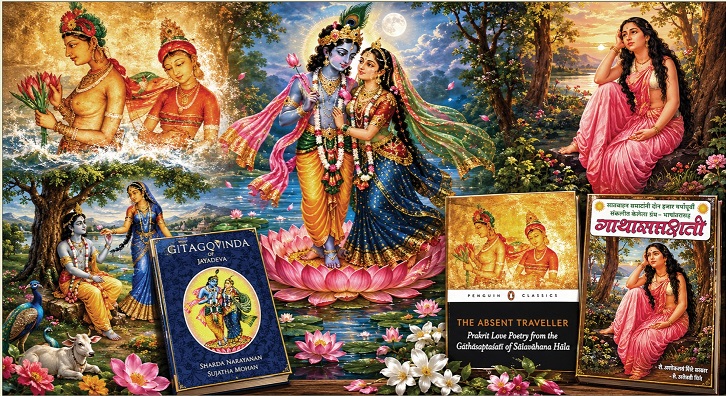
The Gāhasattasai, an anthology of poems compiled by Satavahana Hala, has beautiful, earthy poetry that reflects the joys and sorrows of the common people, not necessarily the rich or famous. It is believed to have been arranged in the 2nd century CE. Here are two examples:
- This indicates a young innocent nayika who is unaware of her pining state, telling her friends that her bangles feel loose, not realizing that she has become emaciated.
सखिकथयसद्भावेनपृच्छामःकिमशेषमहिलानाम्।
वर्धन्तेकरस्थिताएववलयादयितेप्रोषिते॥४५३॥
(सहिसाहसुसब्भावेणपुच्छिमोकिंअसेस-महिलाणं।
वड्ढन्तिकर-ठिआव्विअवलआदइएपउट्ठम्मि॥453)
Friend, I’m worried.
My bangles expand
When he’s abroad.
Is this common?
- This simple verse recalls the rhythm of later dohas or couplets in more recent times.
यथायथाजरापरिणतोभवतिपतिर्दुर्गतोविरूपोऽपि।
कुलपालिकानांतथातथाधिकतरंवल्लभोभवति॥४९३॥
(जहजहजरा-परिणओहोइपईदुग्गओविरूओवि।
कुल-वालिआणंतहतहअहिअअरंवल्लहोहोइ॥293)
As husbands get older,
Poorer, uglier,
Good wives love them
All the more.
- This verse describes the damsel all decked up in her finery, setting out to meet her beloved. This is a classic situation of abhisarika nayika, celebrated in many poems and poetic works and even paintings. Here we see that the poems of Gathasaptasati have set the trend for many later poets such as Kalidasa and Jayadeva.
Sanskrit – चौर्यरतश्रद्धाशीलेमापुत्रिभ्रमान्धकारे।अधिकतरंलक्ष्यसेतमोभृतेदीपशिखेव॥४१५॥
Prakrit – (चोरिअ-रअ-सद्धालुइमापुत्तिबूभमसुअन्धआरम्मि।अहिअअरंलक्खिज्जसितम-भरिएदीव-सीहव्व॥415)
Careful, girl.


Stealing away
Into the night
For the tryst,
Looking brighter
Than a flame.
As a comparison, we can see the 12th verse of XI sarga of the Gitagovinda of Jayadeva.
काश्मीर-गौर-वपुषाम्अभिसारिकाणाम्
आबद्धरेखम्अभितोरुचिमञ्जरीभिः।
एतत्-तमालदलनीलतमंतमिस्रं
तत्प्रेमहेमनिकषोपलतांतनोति॥१२॥
“The damsels have radiant complexion like the golden hue of saffron; as they move about in the night, their face and limbs appear like streaks of gold, against the background of darkness, which is dark as tamala leaves, as if they are the smear of gold which is their love, on the touchstone of darkness.”
Indian culture has been a rich tapestry of intricate patterns since ancient times. It cannot be studied by imposing artificial divisions such as Aryan-Dravidian, Buddhist-Brahmanical, Sanskrit-Prakrit or Vedic- Agamic separations as is often done by Western Indologists. Failing to understand that the Vedic and non-Vedic have co-existed since the beginning of history, they create these divisions, which are more suitable as library sections for convenience, imposing them as serious divisions in society.
It is very interesting to look at lyrics of classical music from the development of language. While folk music may be difficult to understand, Hindustani classical music has compositions that may be very ancient but what we can still relate to. Here is a simple short song of four lines, in fact, two couplets.
Sthayi- स्थायी –
लागीबयरियॉंमैंसोगयीननदि
सैयॉंदुआरे (द्वारे) सेफिरगये…
Antara – अन्तरा –
सगरिरैनामैंतोराहतकटरही
इतनीसीचूकभयीमोरीआलि…
The nayika simply says that as there was a gust of breeze; she dozed off, and in that brief interval her beloved for whom she had been eagerly waiting, came and finding her inattentive, went away from her door. She says she had been very watchful, waiting for him all night, but for a short while she slipped up and in that time, he came and went away. The words only state the facts, while we can understand between the lines, her deep regret and disappointment, aided by the beautiful singing. When she repeatedly states that the breeze blew, she means that she is not to blame, she did not intend to doze off but the wafting breeze putting her to sleep is to blame. While the facts of the poetry are very simple, the world of emotion behind it is gained by dhvani or suggestion, giving the śŗńgāra rasa. Song from traditional repertoire in Hindustani Classical music sung by Padmashri Girija Devi:
Here we may see the similarity or even identity of the words with Prakrit and see the resemblance to the Sanskrit. Bayār is spoken as bayariyan – sounds are similar in some phonemes to Vaayu – in ba and ya. Dvaram is said as du-āre – clearly a pronunciation modification. Sārirāt, sārirātri is spoken as sagariraina…
We know that in Hindustani music, the word ‘āli’ indicates that a lady is being addressed, such as a sakhi of the nayika, as is the case in Sanskrit drama.
So in this manner when we look at a variety of Indian literature from different parts of the country closely, we find that our traditions are largely shared in language, literature and culture. As the Tamil poet Subramania Bharati said a hundred years ago – Mother India speaks in 18 languages, but her thought is one.












 https://www.youtube.com/watch?si=RtToJsBhYBatUrym&v=mOuYNSdhjHA&feature=youtu.be